
Canada’s mental health crisis is no longer a pandemic phenomenon; it’s a sustained workforce emergency. More than 5 million Canadians meet diagnostic criteria for mental health disorders, yet one in three with unmet needs can’t access care. This gap has created unprecedented career opportunities.
The Canadian government projects a moderate to strong risk of labour shortage for therapists through 2033. With 69,900 psychotherapists currently employed and annual growth of 2.0%, job prospects are rated “good” to “very good” across nearly every province. Mental health therapists now earn an average of $100,000 annually, with entry-level positions at $78,400 and experienced professionals earning up to $242,000.
This is all to say, with a career in therapy, one can not only provide for oneself and family, but also respond to these rising demands and make a real difference in the community.
This blog is a step-by-step guide to becoming a therapist in Canada. We will explore the role of a therapist, and the educational requirements and work experience considerations for becoming a registered therapist in your province.

Who is a Therapist?
The American Psychological Association (APA) defines a therapist as an individual who has been trained in and practices one or more types of therapy to treat mental or physical disorders or diseases. They help individuals, couples, and families address emotional, psychological, and behavioral issues to improve their overall well-being.
What is the difference between a therapist, psychologist, and psychiatrist?
Now that we understand who a therapist is, the differences are easier to list.
A psychiatrist has a medical degree and can diagnose clients with mental illnesses and prescribe medications.
A psychologist on the other hand has a degree in psychology and can diagnose mental health issues but cannot prescribe medication.
A therapist does not diagnose or prescribe medication for mental illnesses but primarily uses talk therapy to help with mental health issues.
How to Become a Therapist?
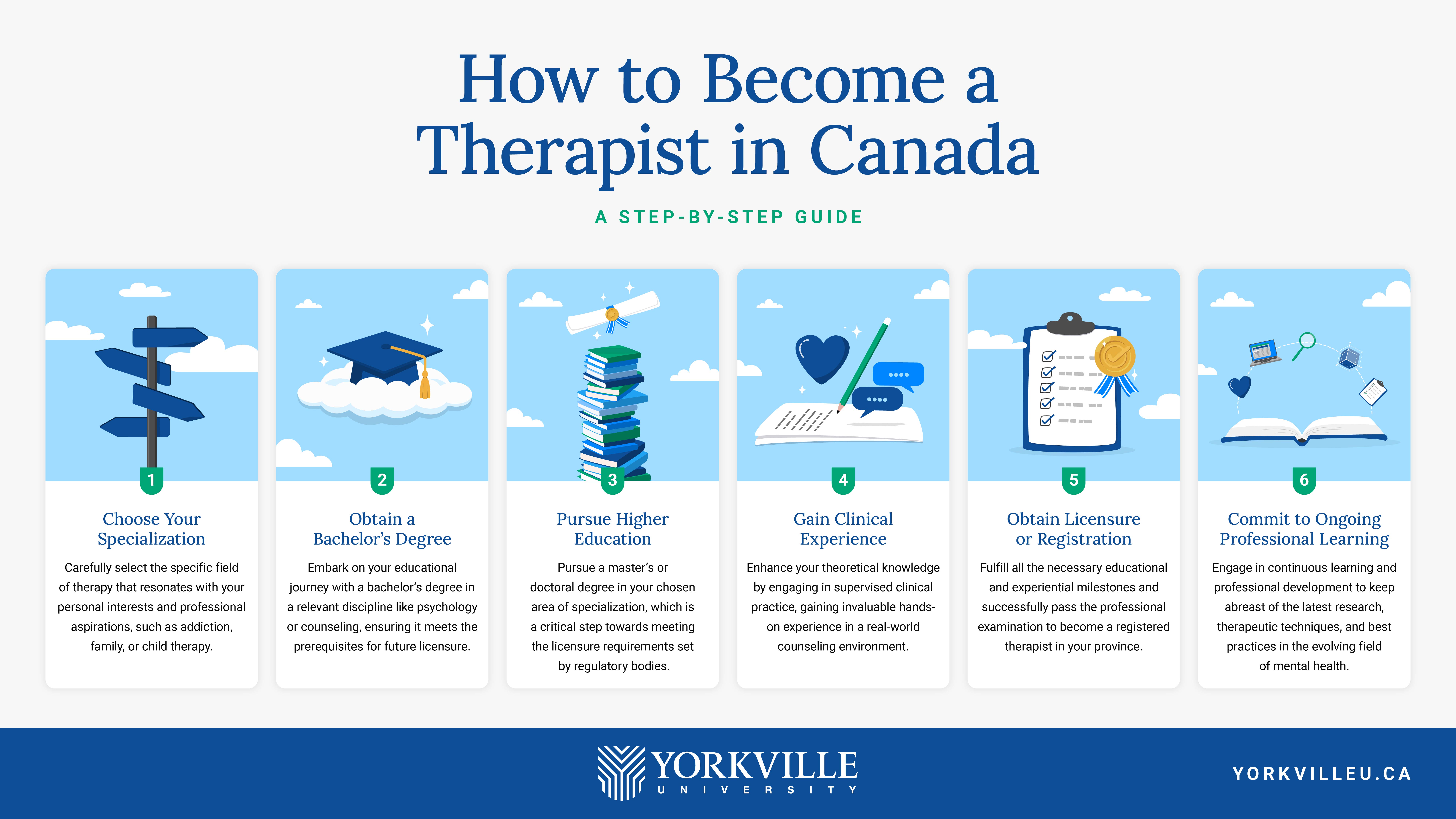
Broadly speaking, the path to becoming a therapist in Canada includes three steps: relevant education, experience, and licensure. Let us further elaborate on the process to include everything you need to know about how to become a therapist in Canada.
Step 1: Choose Your Specialization
The first step when researching the right program for you is to determine the area of therapy that aligns with your interests and career goals. Some of the areas of specialization include addiction, crisis and trauma, couple and family, and child therapy.
Step 2: Obtain a Bachelor’s Degree
Your education and experience all lead up to fulfilling the prerequisites for licensure or registration in your province.
Your educational journey starts with a four-year equivalent bachelor’s degree in psychology, counselling, or other related disciplines. Ensure that the program you choose aligns with the educational requirements of the regulatory body in your province.
Before we continue…
Already have a Bachelor’s degree and looking to pivot to a more meaningful career? Explore our MACP program page today by clicking the button below.
Step 3: Pursue Higher Education
Talking of educational requirements, many if not all regulatory bodies list completing a master’s degree or doctorate in your chosen therapy specialization as one of the licensure prerequisites. Some programs, like the Master’s in Counselling Psychology at Yorkville University, allow you to fulfill the educational requirements of more than one provincial regulatory body.
Step 4: Gain Clinical Experience
When it comes to a career as a therapist, skills practice makes perfect. You have acquired a lot of knowledge through your degrees, now is the time to put them to practice in a supervised clinical setting. Some universities offer a robust practicum as part of their programs, which is a great advantage over others that do not.
Yorkville students, for example, have access to 2,400+ approved sites across Canada. To learn more about counseling practicums, check out our in-depth article all about the topic.
What if your program does not offer a practicum? You still have options. You can take up volunteering opportunities in mental health organizations, community centers, or crisis centers. These opportunities can provide valuable exposure to real-life counseling scenarios and the experience of working with a diverse population.
Step 5: Obtain Licensure or Registration
All that you do from steps 1 to 4 leads up to this. The path to becoming a registered mental health professional in your province includes completing relevant education, fulfilling clinical experience requirements, and, in some cases, passing the licensure examination. We have listed the regulatory bodies for some of the provinces in Canada below.
Step 6: Continue Professional Development
The field of mental health is ever-evolving, and it is important to maintain professional currency to ensure long-term career growth and efficiency of practice. You can do this by staying updated on research and practices through workshops, professional conferences, and additional certifications.
How to Become a Therapist in Your Province
It is essential to register with the regulatory body governing the profession in your province to practice as a therapist in Canada.
While the requirements of the regulatory bodies differ from province to province, here are the licensure requirements for becoming a therapist in these provinces.
Before we bgin, however, it’s important to make a distinction on which provinces have a protected title of “therapist” and which do not.
Is “Therapist” a Protected Title Everywhere in Canada?
Canada has no federal license for therapists or counsellors, and in most provinces the words “therapist” and “counsellor” carry no legal protection at all.
Whether you need to register with a regulatory body depends entirely on two things: which specific title and profession you’re using, and which province you’re practising in.
Only a handful of provinces currently regulate counselling/psychotherapy titles specifically:
-
Ontario — “Psychotherapist” is a protected title under the Psychotherapy Act, 2007. Only registrants of the College of Registered Psychotherapists and Registered Mental Health Therapists of Ontario (CRPO), or one of five other health colleges, may use it. Using it without registration risks fines up to $25,000 for a first offence.
-
Quebec — The title and the practice of psychotherapy itself are both reserved by law. Anyone who isn’t already a physician or psychologist must hold a psychotherapy permit issued by the Ordre des psychologues du Québec, which requires membership in one of seven eligible professional orders, a relevant master’s degree, 765 hours of theory, and a 600-hour supervised practicum.
-
Nova Scotia and New Brunswick — “Counselling Therapist” is a protected title, regulated respectively by the Nova Scotia College of Counselling Therapists and the College of Licensed Counselling Therapists of New Brunswick.
Everywhere else, including British Columbia, Alberta, and most other provinces and territories, counselling and psychotherapy are not currently regulated professions. You can practice as a “counsellor” or “therapist” without provincial registration in these regions, though this is changing: British Columbia is scheduled to bring psychotherapy under regulation via the College of Health and Care Professionals of BC starting November 29, 2027.
Two important caveats apply everywhere in Canada, regardless of province: “Psychologist” is a protected title in every province, always requiring registration with the relevant provincial psychology college regardless of whether counselling itself is regulated there. And unregulated doesn’t mean unqualified or unsafe. Which means a client has no public register to verify credentials against, which is worth knowing as a future practitioner building trust with clients, and worth disclosing transparently in how you market your services.
Why this matters if you’re planning your path: if you’re in Ontario, Quebec, Nova Scotia, or New Brunswick, formal registration is a legal requirement to call yourself a psychotherapist or counselling therapist. If you’re elsewhere in Canada, you can begin practising as a counsellor sooner without waiting on a registration process. Even still, pursuing voluntary certification through a professional association is still strongly recommended for credibility, insurability, and client trust.
With that out of the way, let’s discuss the specifics of each province.
How to Become a Therapist in Ontario
To become a practicing therapist in Ontario you will need to:
- Complete of a master’s degree in psychotherapy or a related field.
- Undergo supervised practice.
- Meet additional requirements of the College of Registered Psychotherapists of Ontario including an examination
How to Become a Therapist in Nova Scotia
To become a practicing therapist in Nova Scotia you will need to:
- Complete a master’s degree in counselling or a related field
- Undergo supervised practice
- Successfully complete the Nova Scotia College of Counselling Therapists (NSCCT) examination.
How to Become a Therapist in New Brunswick
To become a practicing therapist in New Brunswick you will need to:
- Complete a master’s degree in counselling or a related field.
- Undergo supervised practice.
- Successfully complete the College of Licensed Counselling Therapists of New Brunswick (CCTNB) examination.
Quick Summary
Here is your six-step journey of succeeding as a therapist in Canada:
- Step 1: Choose Your Specialization
- Step 2: Obtain a Bachelor’s Degree
- Step 3: Pursue Higher Education
- Step 4: Gain Clinical Experience
- Step 5: Obtain Licensure or Registration
- Step 6: Continue Professional Development
Earn an Master’s in Counselling Psychology Without Putting Your Life On Pause
Want to become a therapist in your province? Become a Registered Counsellor or Psychotherapist with Yorkville University’s online Master of Arts in Counselling Psychology (MACP) program.
Program highlights:
- Accelerated: Earn your degree in as few as 2.5 years.
- Flexibility: Balance your education with life’s demands through our adaptable online format.
- Great Reviews: We have many reviews across Course Compare, Reddit, and Google. Read some of them here.
- Extensive Network: Join over 11,000 alumni and leverage our 2,400+ approved practicum sites to gain real-world experience.
- Fully Online: Complete your MACP entirely online, providing you with the flexibility to learn from anywhere.
How to Become a Therapist Master Table
Regulated?
Regulatory body
Protected Title(s)
Key Requirement
Ontario
Yes
College of Registered Psycho-
therapists of Ontario (CRPO)
Registered Psycho-
therapist
450 client hours + 100 supervision hours for full RP status
Quebec
Yes
Ordre des psychologues du Québec
Psycho-
thérapeute
Master’s + 765 theory hours + 600-hour practicum
Nova Scotia
Yes
NS College of Counselling Therapists
Counselling Therapist
Provincial registration required
New Brunswick
Yes
College of Licensed Counselling Therapists of NBI
Licensed
or Registered Counselling Therapist
Provincial registration required
P.E.I.
Yes
College of Counselling Therapists of PEI
Counselling Therapist (CT)
450 client hours + COMPASS exam + jurisprudence exam
Alberta
Pending (passed, not yet in force)
Association of Counselling Therapy of Alberta (voluntary, for now)
None yet
Voluntary membership until proclamation
B.C.
Pending (effective Nov 29, 2027)
College of Health and Care Professionals of BC (CHCPBC)
None yet
Psychology already regulated by CHCPBC
Sask.
No
N/A (Saskatchewan College of Psychologists for psychologists)
None
Voluntary CCPA membership common
Manitoba
No
N/A (Psychological Association of Manitoba for psychologists)
None
Voluntary CCPA membership common
N.L.
No
N/A (NL Psychology Board for psychologists)
None
Voluntary association membership common
Yukon
No
N/A (territorial psychology regulation only)
None
Psychology regulated since 2025; counselling is not
Northwest Territories
No
N/A (Dept. of Health and Social Services for psychology)
None
No counselling licence required
Nunavut
No
N/A (Dept. of Health for psychology)
None
No counselling licence required
How to Become a Therapist in Canada FAQ
Q: What are the characteristics of effective mental health practitioners?
A: Effective mental health practitioners demonstrate empathy, active listening, cultural competence, and strong communication skills. They also possess the ability to create a safe and non-judgmental space for clients.
Q: How can I become a psychotherapist in Ontario?
A: To become a psychotherapist in Ontario, you need to complete a graduate program in psychotherapy or counseling, accrue supervised clinical experience, and obtain a registration with the College of Registered Psychotherapists of Ontario (CRPO).
Q: What are the education and training requirements to become a professional counsellor?
A: The education and training requirements to become a professional counsellor typically include completing a bachelor’s degree in psychology, counseling, or a related field, and then pursuing a master’s degree in counseling or clinical mental health.
Q: What are the salary expectations for mental health practitioners?
A: The salary expectations for mental health practitioners can vary based on factors such as location, experience, and specialization. On average, licensed therapists, counselors, and psychotherapists can earn competitive salaries, especially in private practice or specialized areas of mental health. According to the latest information from Talent.com, $78,400-$242,000 depending on experience.
Q: How can I become a licensed therapist?
A: To become a licensed therapist, you typically need to complete a graduate program in counseling or clinical mental health, accrue supervised clinical experience, and obtain licensure through the regulatory board or agency in your state or country.
Q: What are the requirements for becoming a psychologist in Canada?
A: In Canada, becoming a psychologist typically requires completing a doctoral degree in psychology, obtaining supervised clinical experience, and obtaining registration or licensure through the regulatory body in the province where you plan to practice.
Q: What is the process to become a counselor or psychotherapist in private practice?
A: The process to become a counselor or psychotherapist in private practice involves completing the necessary education and training, obtaining licensure or registration, building clinical experience, and establishing a professional practice that adheres to ethical and legal standards.
Q: What are the steps to become a registered psychotherapist in Ontario?
A: The steps to become a registered psychotherapist in Ontario involve completing an accredited graduate program in psychotherapy, gaining supervised clinical experience, and obtaining registration with the College of Registered Psychotherapists of Ontario (CRPO).
Q: What is the typical process to become a licensed psychiatrist?
A: The typical process to become a licensed psychiatrist involves completing a medical degree, obtaining licensure as a physician, completing a psychiatric residency program, and obtaining board certification in psychiatry.
Q: What is the path to becoming a social worker in the mental health field?
A: The path to becoming a social worker in the mental health field involves completing a bachelor’s or master’s degree in social work, obtaining licensure or registration as a social worker, and gaining specialized experience or training in mental health settings.