
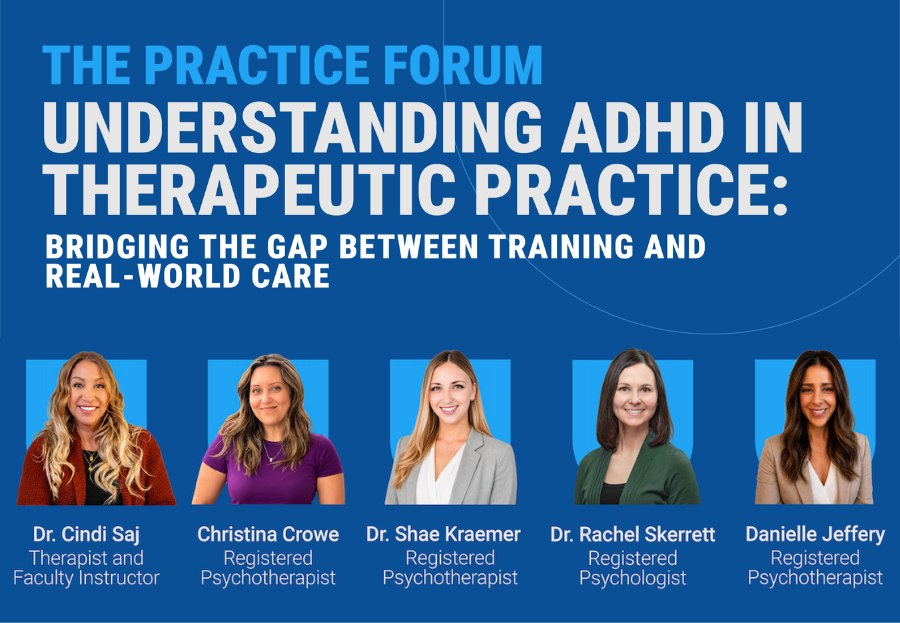
Yorkville University recently hosted the latest instalment of its Practice Forum series, bridging the gap between training and real-world care when it comes to Understanding ADHD in Therapeutic Practice.
.
The July 23 virtual keynote and faculty-led roundtable discussion was hosted by Dr. Cindi Saj, featuring special guest Christina Crowe and panelists Dr. Shae Kraemer, Dr. Rachel Skerrett, and Dr. Danielle Jeffery.
.
Designed for counselling students, early-career clinicians, and practitioners looking to deepen their understanding of ADHD across the lifespan, the session tackled the day-to-day realities of supporting ADHD clients in clinical practice. Discussion centred on the common gaps between academic training and real-world care, along with practical, neurodiversity-affirming strategies clinicians can bring into their own work. The keynote was delivered by Christina Crowe, MACP, RP, CMHP, OVCS, a Registered Psychotherapist.
.
Watch the full discussion HERE!
.
Following the discussion, participants submitted a number of insightful questions during a live Q&A. While time didn’t allow for all of them to be addressed during the session, Crowe and Kraemer have since taken the time to respond.
.
Below, they share their answers to some of the audience’s most thoughtful and pressing questions.
.
When clients have both ADHD and OCD. How does that effect there learning abilities, and would they also have issues with anxiety or depression?
.
Christina Crowe: ADHD and OCD are commonly said to be co-occurring but opposite problems in the brain (opposite patterns of brain activity in the frontostriatal system). Studies show 25% – 30% of people with OCD have co-occurring ADHD, and in people with ADHD, it’s estimated 8% – 15% of people also have clinical OCD (significantly higher than the 2%–3% baseline in the general population). So yes, having both creates overlapping challenges with executive dysfunction, severely compounding difficulties with schoolwork, focus, task completion, and academic performance.
.
At a very basic level, ALL human brains need a balance between stressors (challenges to overcome) and safety, in order to be open/ready to learn. The constant push-pull between seeking novelty (ADHD) and needing control and order to feel safe (OCD) causes profound mental burnout. Compulsions and intrusive thoughts (OCD) eat up study time, while distractibility and impulsivity (ADHD) break concentration.
.
We already know that traditional talk therapy, which typically offers reassurance to clients, can make OCD worse. Similarly, traditional talk therapy without understanding of neurotype can create harm for people with undiagnosed (or unmanaged) ADHD, which is quite anxiety inducing. And untreated anxiety leads to depression. This is why a fulsome assessment and formulation in the beginning and throughout the therapeutic process remains foundational to delivering good care.
.
It was mentioned about fitting the right therapist with the client – do clients generally tend to gravitate more towards therapists that already are diagnosed?
.
Christina Crowe: There is no doubt that ‘birds of a feather flock together’ when it comes to finding the right fit. In fact, the ”double empathy problem” describes how difficult it is to communicate and understand each other across neurotype, so it makes sense that people would gravitate towards those within their own neurotype, regardless of formal diagnosis. If you are a therapist who notices you have a large ADHD population, and you intuitively ‘get’ your clients, you may want to dig into that. Remember, the neurodivergent umbrella is large, and holds both neurodevelopmental as well as acquired forms of neurodivergence, so seeing an experienced clinician would serve any curious minds well.
.
Multiple studies have found that the youngest children in a classroom are at elevated risk of being diagnosed with, or medicated for, ADHD. How should we factor this into our understanding of the prevalence of ADHD generally and among the adult population?
.
Christina Crowe: Actually while this has been the thought for quite some time, a recent high-profile research published in the Journal of Attention Disorders has challenged the classic “relative age effect,” finding no evidence that younger children in a classroom are at higher risk for an ADHD diagnosis during elementary school. It’s a great question that highlights the need for therapists who choose to work in the area of ADHD to continuously find ways to stay on top of a field rapidly exploding with new data, especially in a multi-disciplinary dimension. Attend conferences, stay up to date with great knowledge translation sites like ADHDEvidence.org, have ADHD-specific clinical consultation and an active professional network.
.
Hu, E. H., Faraone, S. V., & Morgan, P. L. (2026). Younger-for-Grade Children are Not at Greater Likelihood for ADHD Diagnosis During Elementary School: Repeated Evidence of a Null Relative Age Effect. Journal of attention disorders, 10870547251415574. Advance online publication. https://doi.org/10.1177/10870547251415574
.
How do we work around the struggle for people to access diagnosis? People often show up with self-diagnosis, what are some benefits of clients utilizing self-diagnosis techniques? And what should we look out for when self-diagnosis is talked about?
.
Shae Kraemer: It definitely can be a struggle for people to access diagnosis aspects as access to formal ADHD assessment can be limited by cost, wait times, geography, or other barriers. It’s understandable that many people begin by exploring the possibility through self-education. Thoughtful self-identification can help clients make sense of lifelong patterns, reduce self-blame, and begin using evidence-informed strategies that improve daily functioning.
.
At the same time, it’s important to approach self-diagnosis with curiosity rather than certainty. Many conditions—including anxiety, trauma, depression, sleep disorders, autism, and even medical issues—can share overlapping symptoms with ADHD. As clinicians, we can validate a client’s experiences while remaining open to multiple explanations. When possible, a comprehensive assessment is ideal, but meaningful support and skill-building don’t have to wait for a formal diagnosis.
.
When you suspect undiagnosed ADHD in a client, how do you recommend bringing it up to them as something to consider? And how do you work with stigma or ableism that might come up?
.
Shae Kraemer: I try to approach it with curiosity rather than certainty. Instead of saying, “I think you have ADHD,” I might say, “I’ve noticed some patterns – such as challenges with attention, organization, or emotional regulation – that can sometimes be associated with ADHD. I don’t know if that’s the right explanation for you, but would you be open to exploring it together?” This invites collaboration rather than labeling.
.
If stigma or internalized ableism comes up, I normalize those concerns and provide psychoeducation. I emphasize that ADHD is a neurodevelopmental difference, not a character flaw, and that seeking an evaluation isn’t about putting someone in a box—it’s about understanding their experiences and identifying supports that may improve their quality of life. Whether or not they pursue a diagnosis, the goal is greater self-understanding, self-compassion, and access to strategies that fit how their brain works.
.
How can ADHD and or Narcissistic Personality Disorder intersect?
.
Shae Kraemer: ADHD and Narcissistic Personality Disorder (NPD) are distinct conditions, but some behaviors can appear similar, such as interrupting others, seeming self-focused, or reacting poorly to criticism. The key difference is the underlying cause. In ADHD, these behaviors often stem from difficulties with attention, impulsivity, emotional regulation, or executive functioning. In NPD, they are more closely related to enduring patterns involving self-esteem regulation, a need for admiration, and difficulty empathizing with others. It is also possible for someone to have both ADHD and NPD, which can make diagnosis and treatment more complex. A thorough assessment is important because effective interventions differ for each condition.
.
Considering the environment and people in it are such an important tool, how do you manage helping a client who is living in a household of untreated ADHD family members?
.
Shae Kraemer: This is a great question as if a client is the only person working on organization, emotional regulation, or routines while other household members have untreated ADHD, it’s important to work with the reality of the environment rather than assuming it will change. Keeping realistic expectations is important as the goal would not be to “fix the household”, but rather to increase the client’s influence over their own experience. The technique of circle of control can be very helpful here as aspects outside the circle of control can lead to frustration and possible burnout. Focusing on personal routines, personal spaces (i.e., bedroom), and creating strategies for managing in a possible chaotic environment can be helpful. Rather than relying on memory aspects, it can also be helpful to incorporate aspects like shared calendars, visual checklists, and labelled aspects as these pieces can reduce the cognitive load for every family member. If the family members eventually become interested in treatment, therapy may expand to include psychoeducation or family work. But until then, effective care usually starts with helping the client build systems that acknowledge the household’s limitations while protecting the client’s own functioning and quality of life.