

Opinion polls report dramatic increases in anxiety and depression symptoms over past three years
TORONTO, ON, January 16, 2026 – Two comprehensive polls conducted in early January by Yorkville University‘s Behavioural Sciences programs and Abacus Data have identified social media usage and youth unemployment as critical factors fueling an alarming rise in mental health challenges among Canadian youth.
The Yorkville University survey polled 724 members of its Master of Arts in Counselling Psychology (MACP) and Doctor of Counselling and Psychotherapy (DCP) community, encompassing front-line counsellors, psychotherapists, graduate students/trainees, practicum partners, alumni and program mentors.
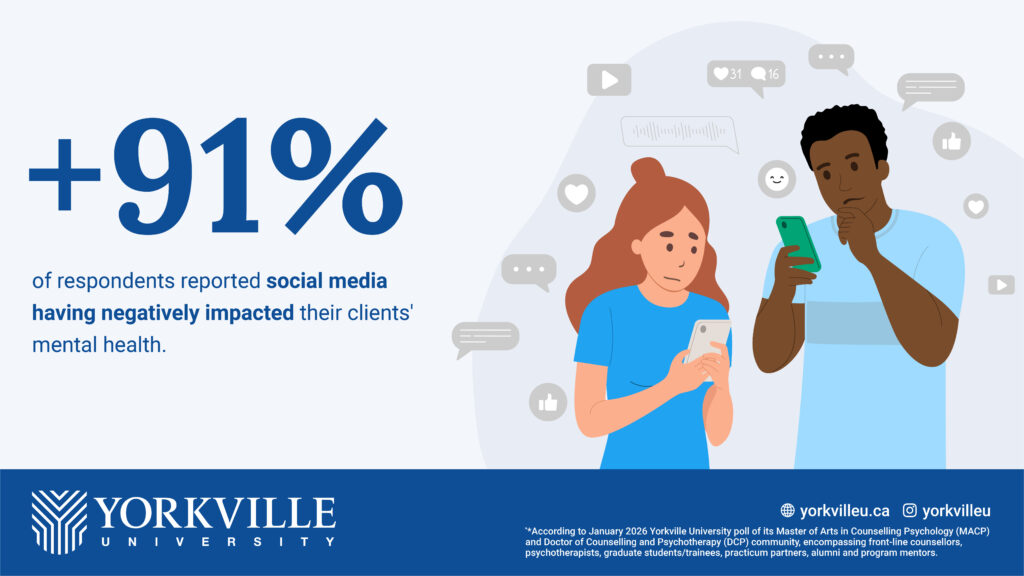
The Yorkville poll revealed that 91% of respondents rated the impact of social media on their youth clients’ mental health as negative, with more than half (51%) describing the impact as “very negative.”
When asked which factors currently have the greatest negative impact on Canadian youth mental health, social media ranked as the number one concern (27%), followed closely by familial dynamics (25%) and interpersonal relationships (24%).
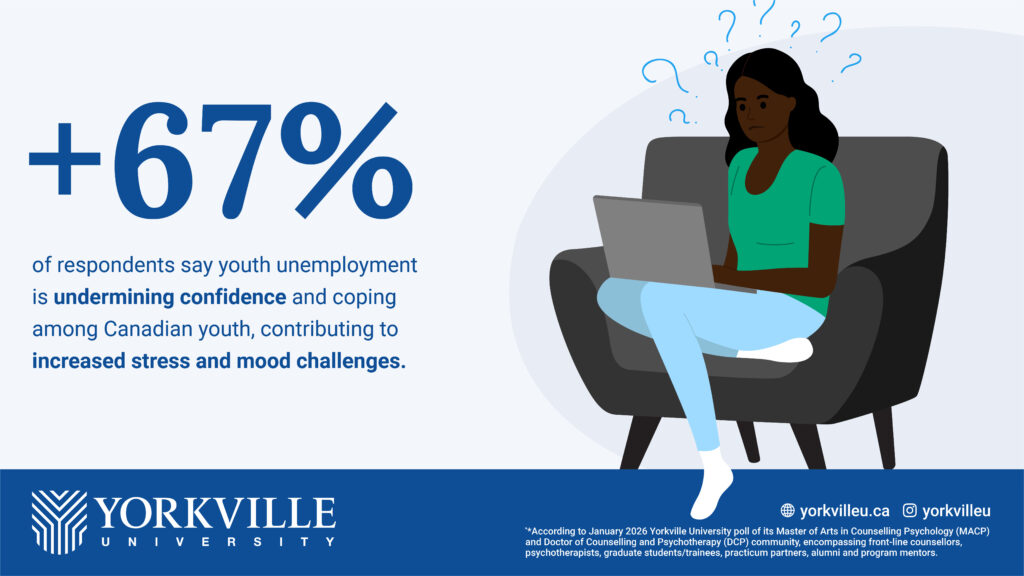
Youth unemployment emerged as another significant concern in the Yorkville poll, with nearly two-thirds (67%) of respondents agreeing that joblessness is negatively impacting the confidence levels of Canadian youth, while 58% reported that youth unemployment is directly affecting young people’s mood, coping abilities, and stress levels.

These findings were reinforced by a separate Abacus Data survey of 1,850 Canadian adults conducted from January 9 to 14, 2026, which found that 69% of Canadians believe social media is having the greatest negative impact on youth mental health, while 42% identified youth unemployment as a major contributing factor.
Among Canadian parents of teenagers aged 15-18 surveyed by Abacus, 68% agreed that youth unemployment has impacted the mental health and confidence levels of their children over the past year.
Mental Health Symptoms on the Rise
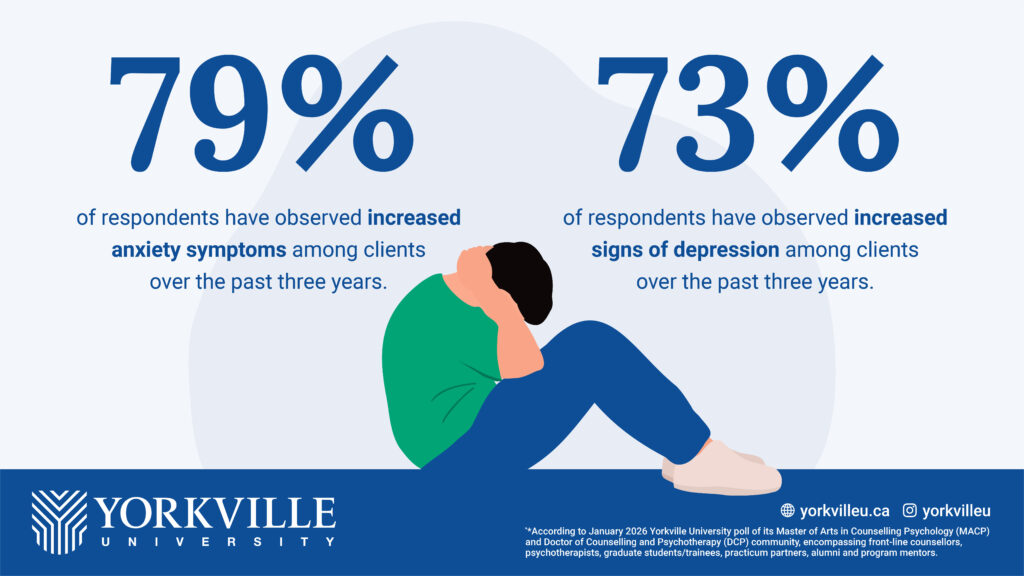
The Yorkville University poll documented significant increases in both anxiety and depression symptoms among clients over the past three years. Nearly 80% of respondents reported increases in anxiety symptoms, with 37% noting the increase as “significant” and 43% observing “somewhat” increased symptoms. Similarly, 73% of respondents reported increased symptoms of depression among their clients, including 24% who observed significant increases.
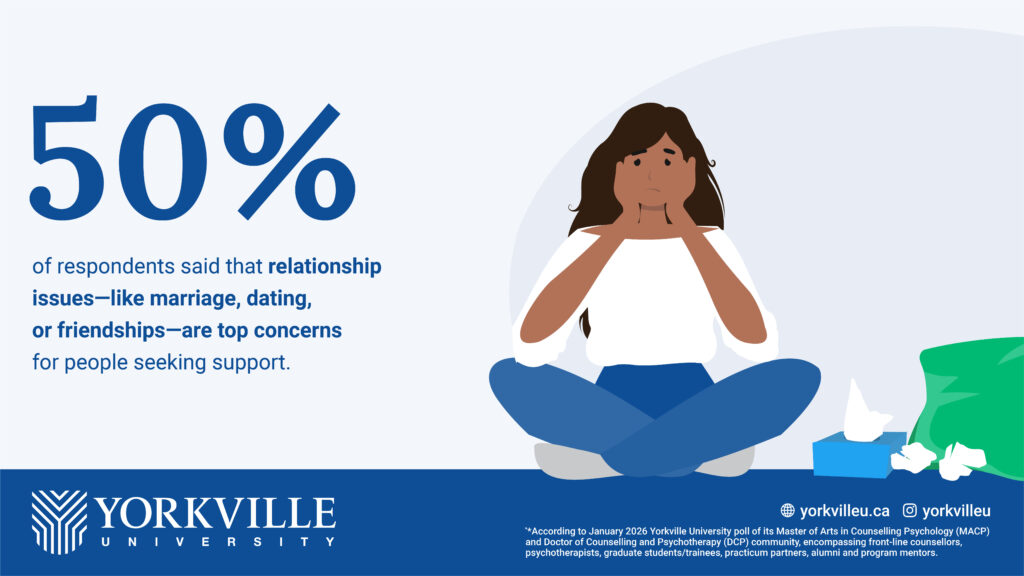
When asked about the most pressing external stressors affecting people seeking mental health support, half (50%) of respondents to the Yorkville poll ranked relationship issues as the number one concern, followed by economic uncertainty and financial hardships (28%), and political uncertainty (9%).
Access and Barriers to Care
Despite the trends noted above, the Yorkville survey revealed a mixed picture regarding access to mental health services. More than 76% of respondents characterized access to mental health care for youth in their communities as somewhat adequate or better, with the following breakdown of the percentage: 9% described it as comprehensive, 33% as adequate, and 34% as somewhat adequate.
However, significant concerns emerged around equity and inclusion. Nearly half (46%) of respondents polled by Yorkville disagreed that mental health services in their communities adequately meet the needs of youth from diverse cultural, social, and economic backgrounds, with 12% strongly disagreeing. Only 25% agreed that services were meeting these diverse needs.
Cost and insufficient insurance coverage emerged as the biggest obstacle for youth in accessing mental health care, identified by 28% of Yorkville poll respondents, followed by lack of parental or family support at 23%.
On a positive note, nearly two-thirds (64.51%) of respondents reported that their practices focus on proactive mental health care for youth, with 33% saying their focus is “very much” on early screening and personalized interventions and 31% reporting “somewhat” of a focus.
Addressing Youth Loneliness and Social Isolation
When asked about the most effective interventions for reducing youth loneliness and social isolation, respondents polled by Yorkville identified school-based social programs as the top solution (26%), followed closely by peer support groups (25%), mentoring programs (20%), and counselling or therapy (19%).
“These findings underscore what our frontline mental health professionals are witnessing every day in their practice – Canadian youth are facing unprecedented challenges to their mental health and wellbeing,” said Dr. Michelle Grimes, Vice President, Academic and Campus Principal at Yorkville University’s New Brunswick campus.
“The data is clear: social media and youth unemployment are significantly impacting young people’s mental health, contributing to substantial increases in anxiety and depression symptoms over the past three years. At Yorkville University, we’re committed to training the next generation of mental health professionals who can meet these evolving challenges with evidence-based, compassionate care.”
For Yorkville University President and Vice Chancellor Dr. Julia Christensen Hughes what stood out most in the research was a powerful human truth: That despite all the economic and political uncertainty we face, relationships remain at the heart of mental health for people of all ages.
“For our youth struggling with loneliness and isolation, the solution isn’t found in their screens – it’s found in school-based programs, peer support, and mentoring that foster genuine human connection,” she said. “This research reminds us that mental wellness, now more than ever, depends on putting down our devices and investing in the relationships that sustain us.”
Opinion Poll Details
Yorkville University: From January 10-14, 2026, Yorkville University conducted an opinion poll among its community of front-line counsellors, psychotherapists, graduate students, practicum partners, alumni and program mentors to assess the current state of mental health care. Questions were posed to 724 respondents from the Yorkville University community.
Abacus Data: Abacus Data fielded a number of questions for Yorkville University on an online omnibus survey of 1,850 Canadians between January 9 and 14, 2026. Abacus Data is a boutique market research firm staffed by strategic thinkers and data experts who explore the unknown and anticipate where public opinion is moving to equip clients with actionable insights that allow them to respond to emerging challenges and opportunities.

About Dr. Michelle Grimes
Dr. Michelle Grimes is the Vice President, Academic and Campus Principal (New Brunswick) at Yorkville University, where she oversees the Master of Arts in Counselling Psychology (MACP) and the Doctor of Counselling Psychology (DCP) programs.
With more than 17 years in postsecondary leadership, she has held senior roles across the Canadian college and university sector, including Executive Dean of the School of Business at Conestoga College, Dean of the McKeil School of Business at Mohawk College, Chair of Business at Conestoga College, and Chair of Media at Seneca Polytechnic. She is recognized for advancing innovation, student success, and faculty engagement, and has received several honours, including the PRME North America Dean’s Excellence Award for Institutional Leadership.
Dr. Grimes holds a PhD in Leadership and Public Policy from Niagara University, a Master of Education from the University of Prince Edward Island, and bachelor’s degrees in journalism and Radio and Television Arts from Toronto Metropolitan University.
She is available to media to discuss these opinion poll findings.
About Yorkville University
Yorkville University began with a bold vision: to offer flexible, rigorous, and career-focused programs that transform lives. Since 2004, Yorkville University has expanded to campuses across Canada, offering both online and on-campus programs. Our graduates have advanced their careers through programs in the behavioural sciences, social sciences, business, design and the creative arts. Yorkville University’s student-centred, practitioner-oriented approach equips graduates with skills that employers value, making us one of Canada’s largest private universities. Learn more at https://www.yorkvilleu.ca/