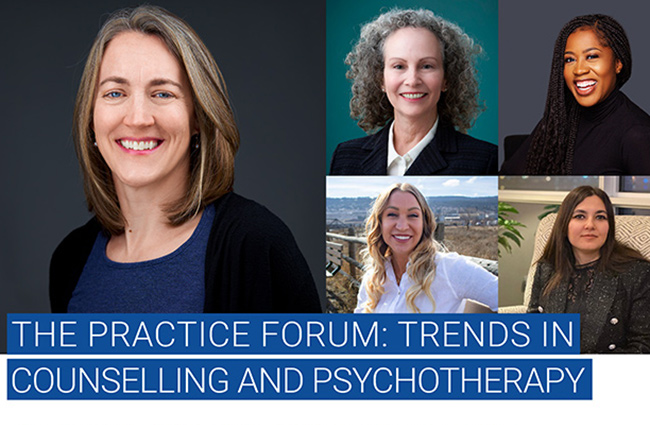
Yorkville University recently hosted the second session in its The Practice Forum series, bringing together academic and clinical perspectives to explore Mental Health in High Performance Contexts and the unique challenges of supporting high-performing clients.
The March 5 forum featured keynote speaker Dr. Danelle Kabush, Program Chair of the Doctor of Counselling and Psychotherapy program, alongside guest speaker Jhanelle Peters, Registered Psychotherapist. Together, they examined how counsellors can effectively work with individuals operating in high-performance environments while maintaining strong ethical and clinical foundations.
Designed to support MACP students, alumni, and mental health practitioners in navigating emerging issues in counselling and psychotherapy, the conversation was further enriched by a faculty panel discussion with Dr. Cindi Saj, Dr. Avideh Najibzadeh, and Dr. Stacey Hatch. Over the course of the session, the speakers explored key themes including high-performance contexts in counselling practice, risk and scope in clinical work, supporting high-performing clients in therapy, and career pathways at the intersection of performance and mental health. Nearly 400 attendees joined the forum for a thoughtful and engaging dialogue.
Following the discussion, participants submitted a number of insightful questions during a live Q&A. While time didn’t allow for all of them to be addressed during the session, Kabush and Peters have since taken the time to respond.
Below, they share their answers to some of the audience’s most thoughtful and pressing questions.
Is the CMPC certification applicable to other high performing domains? (e.g. high-profile musical artists)?
Dr. Danelle Kabush: Yes, CMPC certification is for professionals who specialize in the mental aspects of sport and performance. Working on developing mental strategies to enhance performance consistency, to overcome barriers like anxiety, self-doubt, and motivation, learning strategies to stay focused under pressure are all skills that artists need and develop. Furthermore, working on skills to maintain a healthy balance between performing arenas and personal life certainly can apply to any other domain in life such as the performing arts, and career-life balance.
.
What do you do if the client is only interested in getting help to win, but that conflicts with good mental health?
Dr. Danelle Kabush: First, we would need to explore if getting help to win, or to succeed in reaching one’s full potential does in fact conflict with mental health, because it doesn’t need to. I would start by exploring with the following questions and motivations for winning with a client. What does “winning” mean to you? What are the values you bring to your “winning journey”? Who is most important to you along this journey? What motivates you most in your pursuit? What areas of your life are you willing to take a step back from (sacrifice) to give it your best shot? The more we can break down and understand the meaning of winning with an athlete, or success with any client, the more we can provide a space to reflect on their lessons to date, explore whether it aligns with their values, and plan for a pathway forward that not only supports reaching their potential, but also supports their overall well-being and mental health. Winning and mental health can go together when adaptability, flexibility, and an overall and sustainable balance is achieved – one that ideally supports both physical safety and well-being, as well as psychological safety and social connection beyond sport or performance. The caveat here is that a goal of winning or giving it one’s best shot at a sport or performance goal may be the acknowledgment that other life goals or even relationships may need to be put on hold for a period of time.
Do you have tips for the mental health of a Toronto Maple Leafs or Detroit Lions fan?
Dr. Danelle Kabush: First, you need to instead think about supporting the Vancouver Canucks and the BC Lions (kidding). Jokes aside, if you feel your mental health is affected negatively because of supporting your favourite teams as a fan, this may be partly due to over-identifying with your favourite teams. It is normal and healthy to feel elated when our favourite teams (or athletes) are doing well and are winning, and disappointed when they lose. However, if it is affecting your own self-worth and emotional well-being in your own personal life, it may be time to take a step back, or a mindful break to focus on other aspects of your life and identity.
Jhanelle Peters: There is nothing wrong with holding on to the moments that made you a fan in the beginning. Step away, as Danelle mentioned, and come back when you feel like a fan again, not someone consumed by the challenges the team faces.
I had a question regarding distress tolerance during physical exercise, and if/how this translates to distress tolerance outside of physical activity. Does pushing past thoughts of “Stop running you’re tired, just give up etc.” in a physical environment improve an ability to do so in a mental capacity (self-discipline, improving window of tolerance, general resilience etc)?
Dr. Danelle Kabush: Any activity that pushes you just beyond your current comfort zone, whether that be a physical, mental or even emotional comfort zone, is likely going to lead to growth, increased focus, and the confidence of working towards mastery of a task, whether that be a physical endeavor in sport, a mental one in academics or one’s career, or an emotional one in relationships with ourselves and others. In other words, doing hard things and succeeding in one arena can increase our confidence and provide a ripple effect that can translate to other areas. For example, there is plenty of research that connects participation in sports and exercise – particularly for youth and adolescents, and even more so for girls – to success and confidence in other areas of life.
How do counselling high performers in sports and high performers in other fields overlap?
Dr. Danelle Kabush: Many of the same skills and strategies apply to succeeding in other arenas – things like goal-setting and -planning, pre-performance routines, mental rehearsal, focusing, managing distractions, and strategies to manage pressure and performance anxiety. There are physical overlaps, as well. While succeeding athletically by nature requires prioritizing adequate recovery – sleep, nutrition, rest – performers in any other field can benefit from taking care of their physical health and monitoring/managing their own stress-adaptation-recovery cycles.
Jhanelle Peters: Sport definitely makes an easy connection when we think of high-performance. But high-performance shows up in so many spaces with lots of overlap like Danelle mentioned. For me, high-performing individuals have three things in common. They are people who consistently operate in:
– High-pressure environments where the expectations are high
– The margin for error is small
– Their performance is constantly being evaluated
.
What you will see in common among many of these individuals is that their identity is wrapped up in performance and in having it all together, and in a lingering fear of failure despite their success. I attribute much of this to the fact that the goal post keeps moving, even after you’ve done your best work.
.
What skills, strengths, or experiences are required to become a performance counsellor?
.
Dr. Danelle Kabush: Like many areas of specialization in counselling and psychotherapy, we tend to serve clients best when we are passionate and knowledgeable about the topic. If you enjoy learning, reading, talking about, exploring and applying skills and strengths related to performance in your own life, you will likely enjoy working with clients who wish to focus on their performance.
How do you manage putting the athlete as the focus of your interventions while also managing the ‘client’s’ expectations (ie sport association, coaches, team managers, family members)?
Dr. Danelle Kabush: Just like counselling with a minor, a couple or a family, you need to be clear on who is the client you are serving, as well as the limitations of confidentiality within the ethics of your practice and credentials, regardless of who hires you. For example, a parent may seek out a counsellor to work with their child athlete, but regardless of what their agenda might be in seeking out your services, you need to be clear on the boundaries, limits and ethics of what services you will provide, and under what limited conditions, or with consent, information will be shared with a parent, coach, or sport association.
Jhanelle Peters: I agree that attention and responsibility lie with the client. Role clarity is important. In counselling, this focus is on the person and their overall well-being – including their emotions, relationships, identity, and mental health. Remembering this can help you focus on the athlete rather than others that may steer you into aligning their needs. Clinicians need to stay grounded in supporting the person first, even when working in high-performance settings environments.
My son is a competitive kart racer who wants to drive in Formula 1. How do you foster a flexible and growth mindset in young athletes who have talent and big dreams, but their attitude is holding them back? I am interested in working with children who may be facing the pressures of striving to become elite athletes and preventing mental health issues.
Dr. Danelle Kabush: First, having worked with many parents of athletes, focusing on keeping it fun for your son is important. Athletes often feel enough pressure from coaches, and themselves. As parents, our job is to support their dreams within what is feasible for any given family and focus on their well-being from a holistic perspective with unconditional love. Ask not, did you win today? Instead ask, did you have fun today? What was practice like? What did you learn? What was most challenging? The more we focus on the process, and self-learning that can come out of sports, the more we can foster the development of a growth mindset in young athletes. A mindset that is excited by working towards mastery, that can develop resilience through mistakes and setbacks, and ultimately recognize that performance does not define us, but can become an expression of who we are.
.
Jhanelle Peters: I couldn’t agree more. Additionally, remembering why they loved the sport in the first place and making sure that element still remains throughout is important. That reason for starting needs to stay present, even when things get more intense.
.
I still miss artistic swimming (synchronized swimming). It has been 25 years and I still want to go back to those days. Is that normal?
.
Dr. Danelle Kabush: Yes, this is normal! It is positive that you are looking back at your artistic swimming days fondly. Some athletes finish their careers with delusion and bitterness, which can also be impacted by negative competitive experiences or how their career ended. You might choose to reflect on what parts you miss most about those days? What are the biggest lessons that that time in your life taught you? While you recognize you cannot go back there completely, are there parts of that time that you can bring back to or even recognize in your current life today – the shared goals in team environment or a new physical training goal? What are you grateful for in how those days shaped who you became and are today?
.
Jhanelle Peters: A strong emphasis on revisiting this space with a new goal and purpose; ensure it aligns with your current position in life. Consider whether some aspects you miss can be applied to other parts of your life. For instance, I often think about the connection with my teammates; maybe you’re seeking new connections and interactions with others.
.
I’m curious about the issues of addiction with retired athletes.
.
Dr. Danelle Kabush: This is a big question and depends on many factors such as genetics, environment and sometimes unresolved trauma from life or sport that can rise to the surface when the focus of sport is no longer at the centre of one’s day-to-day life and routine. It is also common that the loss of instant feedback and dopamine that comes from training and competition, identity, and often the external recognition and validation, can be a hard void to fill when an athlete retires. Sometimes addiction issues are also related to career injuries or changes in the brain due to concussions. However, the more we can work to support athletes to plan for and work through the retirement transition, the better equipped they will be to channel the loss and grief of this significant identity change into more positive and healthy ways of coping or redirecting their athletic skills in a new direction.
.
What would you say is the most fulfilling part of working with high performance individuals? Do you experience higher levels of burnout as a clinician?
.
Dr. Danelle Kabush: For me, the most fulfilling part of working with high performance individuals is the opportunity to play a meaningful role as one person in their support team. In a world where athletes and performers face many daily pressures and expectations from themselves, family, coaches, media and sponsors, a counsellor can provide a soft landing place to talk openly with someone who is not there to judge, and simply provide neutral support and feedback – someone who cares much like a loving parent would – about their whole self and well-being. Just like any practitioner, burnout can occur if we spread ourselves too thick and, in sport contexts, there can be extra demands to travel with teams present in the sporting environment, which can sometimes be a risk to burnout if the practitioner is away from family and daily routines that support and sustain their own well-being.
Jhanelle Peters: The most fulfilling part for me is being able to carve out a space for these individuals to be human and not their title, position, or role. Very similar to what Danelle shared, I like watching their brains at work and how they navigate their fast-paced world. For example, a goalie can see several plays at once and anticipate others; their brain and eyes are working at lightning speed. When it comes time to slow down and process, some tend to want to speed up and find the quickest and most efficient outcome, instead of slowing down and feeling. Not because they can’t, but because it is what they are used to. I love watching this in action and supporting.
How does/can a concussion impact the counselling process?
Dr. Danelle Kabush: It can be helpful, with consent, to consult with the athlete’s coach and/or medical provider for a team approach to support. Otherwise, counselling skills that apply include educating yourself on concussions, normalizing the anxiety in returning to their sport, and that recovery is not linear (unlike many other physical injuries), and can cause a lot of emotional symptoms and frustration, focusing on the process, and helping them stay connected to social network and sport.
Wondering if you have any ‘real world’ advice when it comes to implementing the holistic high performance culture framework in established sport coaching teams? For context, they’re very ‘old school’ in the sense that psychological safety comes after enough success and doesn’t fit neatly into the daily training environment.
Dr. Danelle Kabush: This is a great question. I’ve been in environments where the expectation is that the mental performance practitioner should come in and change the culture of a team. While the mental performance consultant can certainly have a role to play in influencing the team culture, it is very challenging to do when it is not aligned with the coach’s or organization’s philosophy. Even in high level, well-supported and staff sport environments, the coach plays a primary role in establishing the culture of a team. The good news is that there is more and more training available for developing coaches such as:
– Mental Health First Aid Courses: www.mhfa.ca
– Coaching Association of Canada (CAC) Mental Health and Sport Resource Hub: Mental Health and Sport Resources | Coaching Association of Canada | Association canadienne des entraîneurs
– Safe Sport: Canada.ca
– www.abuse-free-sport.ca | Sport Help Line: 1-888-837-7678
– Canadian Centre for Mental Health and Sport (CCMHS) – Providing specialized mental health services, training and education: Mental Health Care — Canadian Centre for Mental Health and Sport
Jhanelle Peters: Coaches Association of Ontario also offers great training and partnerships focused on the mental health component of coaching.
As a mental health professional who doesn’t have a qualification in CMPC, how do you navigate scope of practice with performance and mental health being so tightly interlocked?
Dr. Danelle Kabush: As I mentioned in the webinar, it can be hard to make clear the line or distinction between focusing on enhancing performance versus addressing mental health issues, as they do tend to overlap. However, in the webinar we also touched on the sometimes-false assumption that if one is performing well, then they must doing great in terms of mental, or even physical health. Overall, it is important to be clear about your scope of practice and training. Do you want to focus on addressing mental health in performers, mental performance or both? Mental health practitioners are set up well to focus on both, but I do recommend some further training if on the psychology of performance, as well.
How do you balance the need to give advice (coaching) vs. support (traditional counselling)?
Dr. Danelle Kabush: As a registered clinical counsellor, I stay away from giving direct advice. What I do share are common strategies and techniques I have observed that have worked with other athletes and then ask what the client in front of me has tried or what their goals are. That said, sometimes younger athletes (youth or adolescent) need to be given a few more menu items to start exploring and it can start with psychoeducation to promote mental skills strategies, while also developing their self-awareness skills as they are working on developing their own identity through sport, as well. It often comes to down to asking good open-ended questions! Your expertise and guidance come from your evidence-informed knowledge of a healthy performance mindset and work with other performers, and perhaps your own life experiences, as well.
Does it take athletes a long time to find identity after they are no longer do their sport?
Dr. Danelle Kabush: It varies, but it can generally take 6 months to a year to adjust to the loss of primarily identifying as an athlete. In working with athletes who have moved away from sport, it is important to normalize the loss, potential feelings of grief and the time the adjustment period can take. Some athletes feel they shouldn’t be feeling so upset as it is “just sport,” but normalizing and validating their emotions during this time is important. As well as working on the transferable skills they are taking with them, and reframing and expanding their “athlete identity”. For example, continuing to stay active and finding a new relationship with their physical exercise goals can make the adjustment much easier than quitting sport and exercise cold turkey.
What might make these clients resistant to change or disengage and dropout?
Dr. Danelle Kabush: Some of the barriers mentioned in the webinar: parents or coaches who do not support mental health and wellbeing along with performance expectations; fear of being seen as weak, not getting play time or not making a team for self-disclosing one is struggling or seeking mental health support; being self-reliant; and equating mental toughness with just pushing through at all costs. A fear that working through and feeling emotions will take away from performance, when, in fact, if done well, it can be the opposite – addressing and working through one’s whole range of emotions can clear blocks to performance and ultimately be tapped into to fuel performance.
I’m transitioning into counselling after a 20-year career in film and television, where I’ve worked inside high-performance environments and seen the pressures of perfectionism, burnout, and identity tied to performance. I’m interested in eventually building a niche private practice supporting high-performing creatives like musicians, artists, and performers. From a practical standpoint, what are the first steps a new therapist can take to ethically build that kind of niche practice? For example, how do you begin building credibility and visibility within those communities while staying within CRPO guidelines around promotion and professional boundaries?
Dr. Danelle Kabush: Sounds like you have a great background to support such clients and help develop rapport. Just like athletes who often place higher value in working with someone who can relate to their struggles or personally connect with other parts of their identity (ethnicity, culture, gender, sexuality etc), this can help build your rapport with clients from these backgrounds. Practically speaking, outside of the traditional marketing for the clients you hope to attract and enjoy working with, you might start by offering some psychoeducational workshops within these communities to start gaining some exposure and familiarity with your area of expertise and the clients you’re aiming to serve. As a younger practitioner, providing psychoeducational workshops or team sessions, often resulted in more individual reach out for 1:1 work, as well.
Jhanelle, I am starting my practicum in September but noted on your website that you are not currently accepting practicum applications. Can you recommend any clinics (online or offline) that offer exposure to performance anxiety, injury rehabilitation, identity loss, etc. in practicum?
Jhanelle Peters: Yes, I have secured all my placement students for 2026. I honestly do not know of any clinics that offer direct exposure. You can try connecting with this practitioner as I know she works in the Olympics arena, and might be able to share more insight: https://www.psychologytoday.com/ca/therapists/renee-raymond-north-york-on/426096
–––––––––––––––––––––––––––––––––––––––––
Free Online and Validated Assessments for Athletes
.
Psychological Safety
..
The Team Psychological Safety scale (TPS-7) is a 7-item self-report measure designed to assess psychological safety within high-performing teams. Psychological safety represents a shared team belief that members can engage in interpersonal risk-taking behaviours—such as asking questions, admitting mistakes, proposing new ideas, or challenging existing approaches—without fear of negative consequences to their self-image, status, or career (Edmondson, 1999).
.
Edmondson, A. (1999). Psychological Safety and Learning Behavior in Work Teams. Administrative Science Quarterly, 44(2), 350-383. https://doi.org/10.2307/2666999
Assessment: Team Psychological Safety (TPS-7)
.
Athlete Psychological Strain Questionnaire (APSQ)
.
The Athlete Psychological Strain Questionnaire (APSQ) is a 10-item self-report measure designed to assess psychological distress and strain specifically in elite athletes aged 18 years and older.
.
Rice, S.M., Parker, A.G., Mawren, D., Clifton, P., Harcourt, P., Lloyd, M., Kountouris, A., Smith, B., McGorry, P.D., & Purcell, R. (2020). Preliminary psychometric validation of a brief screening tool for athlete mental health among male elite athletes: the Athlete Psychological Strain Questionnaire. International Journal of Sport and Exercise Psychology, 18(6), 850–865. https://doi.org/10.1080/1612197X.2019.1611900
.
Assessment: ACSI-28 – Athletic Coping Skills Inventory
.
Athletic Coping Skills Inventory (ASCI-28)
.
The Athlete Psychological Strain Questionnaire (APSQ) is a 10-item self-report measure designed to assess psychological distress and strain specifically in elite athletes aged 18 years and older.
.
Smith, R. E., Schutz, R. W., Smoll, F. L., & Ptacek, J. T. (1995). Development and validation of a multidimensional measure of sport-specific psychological skills: The Athletic Coping Skills Inventory-28. Journal of Sport and Exercise Psychology, 17, 379-398. https://doi.org/10.1123/jsep.17.4.379
.
Assessment: ACSI-28 – Athletic Coping Skills Inventory
.
Leadership Scale for Sport (LSS-15)
.
The LSS-15 captures athletes’ experiences and perceptions of their coach’s leadership style, providing valuable insight into the coach-athlete relationship and leadership effectiveness from the recipient’s viewpoint.
.
Teques, P., Silva, C., Rosado, A., Calmeiro, L., & Serpa, S. (2020). Refining the Short Version of the Leadership Scale for Sports: Factorial Validation and Measurement Invariance. Psychological Reports, 1-25. https://doi.org/10.1177/0033294120953560
.
Assessment: LSS-15 – Leadership Scale for Sports
.
International Olympic Committee Sport Mental Health Assessment Tool (SMHAT1)
.
The International Olympic Committee (IOC) Sport Mental Health Assessment Tool 1 (SMHAT-1) is a standardized assessment tool aiming to identify at an early stage elite athletes (defined as professional, Olympic, Paralympic and collegiate level; 16 and older) potentially at risk for or already experiencing mental health symptoms and disorders, in order to facilitate timely referral of those in need to adequate support and/or treatment.
.